

Feb 2, 2026
MRP in Manufacturing: From Dependent Demand to Material Requirements
MRP converts assembly demand into dated material requirements using BOM quantities, inventory, scheduled receipts, and lead times. Accurate inputs help prevent shortages and unnecessary purchasing.
Why MRP manufacturing matters
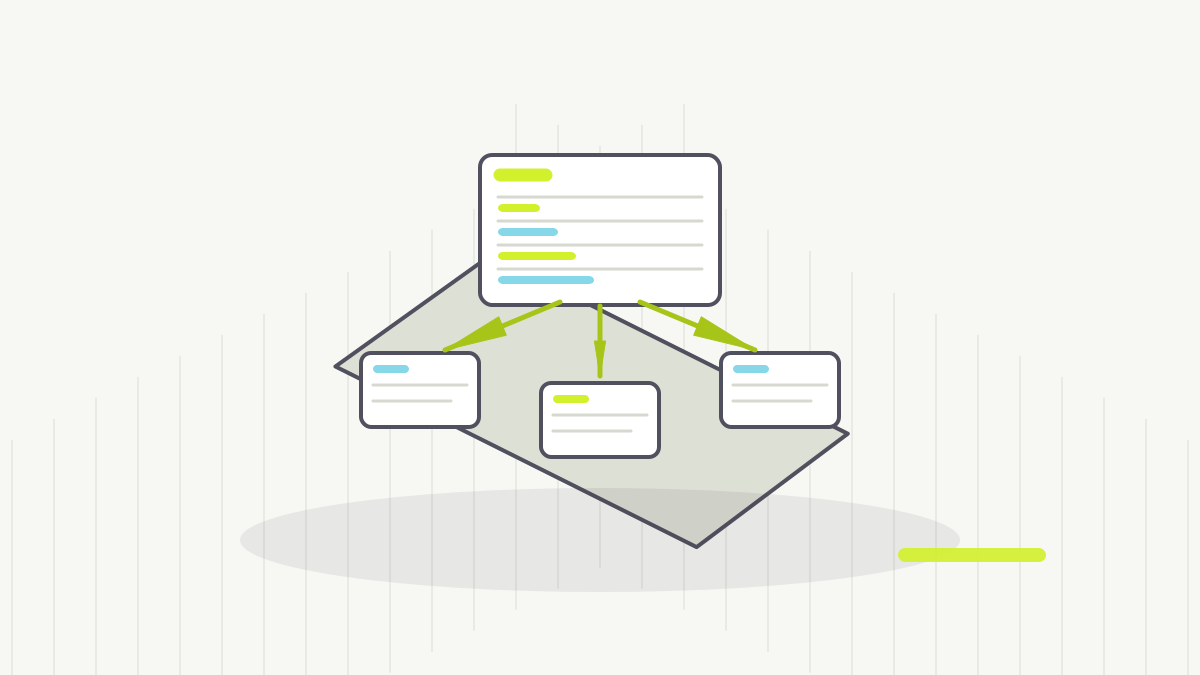
An order for 200 assemblies does not mean purchasing 200 of every component. Some parts are used twice per assembly, some are already in stock, and others are due from suppliers before production starts. MRP turns the assembly requirement into dated component requirements by exploding the BOM, netting available stock and scheduled receipts, and offsetting supply by lead time. Its recommendations are only as dependable as those inputs: an incorrect quantity or receipt date can create either a shortage or an unnecessary purchase.
A stronger operating model starts with one consistent representation of demand, items, resources, routes, bills of material, calendars, inventory and orders. factory.online is structured around this connected manufacturing model: sales requirements can create manufacturing demand; manufacturing requirements can drive material and capacity calculations; executable work can be scheduled against resources; and actual confirmations can feed the next planning cycle.
The operational problem
The core challenge is synchronization. Boms, stock, scheduled supply, lead times and dependent demand change at different speeds and are often owned by different teams. A customer order may change after materials have been purchased. A machine may become unavailable after the schedule is released. A late receipt may make an otherwise feasible sequence impossible. A capacity decision may shift dependent material demand into another period.
Manufacturers therefore need more than a static plan. They need calculations and workflows that preserve relationships between commercial demand, production requirements, material supply and execution. The objective is not to automate every decision. It is to make constraints visible early enough for planning, procurement, production, quality, logistics and sales to work from the same operational picture.
How the process should work
A practical model has four connected layers. First, demand and requirements: start from sales orders, forecasts, replenishment needs or other approved demand and translate them into products, semi-finished goods, operations and materials. Second, feasibility: test whether capacity and materials support the requested timing using RCCP, MRP, shortage calculations or detailed resource checks. Third, execution: convert feasible requirements into manufacturing orders, job orders and scheduled operations, assigning work to work centers against calendars, maintenance, transfer times, changeovers and priorities. Fourth, feedback: record output, receipts, issues, transfers and confirmations so the next calculation uses the latest factory state.
The quality of this loop depends on master data. Item definitions, units of measure, BOMs, routes, operations, work centers, alternative resources, time tables, transfer times, replenishment settings, changeover rules and inventory locations must describe the real operating model closely enough for the calculation to be useful.
Where factory.online fits
The current factory.online documentation covers sales orders; manufacturing orders and job orders; aggregated job orders; output confirmation and finished-goods receipt; MRP and RCCP; scheduling calculations; purchase requisitions and purchase orders; goods receipts and issues; customer and supplier returns; stock adjustments and transfers; batches and containers; shortage and replenishment calculations; products and materials; standard and actual cost; locations, resources, work centers, operations, routes and BOMs; planning scenarios; replenishment, shortage, aggregation, cross-location and changeover rules; maintenance schedules; integration APIs; and Power BI integration.
For companies already using SAP, Oracle or another ERP, factory.online does not need to duplicate the enterprise core. The ERP can remain the system of record for agreed business objects while factory.online receives the data required for advanced manufacturing planning and returns relevant planning or execution results. A good integration defines ownership of items, resources, orders, stock, purchasing documents and confirmations explicitly.
Implementation checklist
Before automating this area, agree on planning horizons, time buckets, order ownership, item and resource identifiers, BOM and routing governance, inventory accuracy, calendar maintenance, confirmation rules and exception ownership. Integration should be designed around stable business objects rather than screen-to-screen replication.
A good first milestone is not "optimize everything." It is a trustworthy closed loop from demand to feasibility to execution to feedback. Once that loop is stable, optimization, scenario comparison and AI-assisted decision support can add value without hiding weak data foundations.
Related factory.online guides
- S&OP for Manufacturers: From Commercial Demand to an Operationally Feasible Plan
- Production Orders as the Integration Object Between ERP and Manufacturing Planning
- Safety Stock and Reorder Point: Choosing the Right Replenishment Logic
- SAP and Manufacturing Planning: Building an Execution-Oriented Integration
Key takeaway
Mrp Manufacturing creates value when it is connected to the same operational data used for demand, materials, capacity and execution. A closed planning loop makes constraints visible earlier and gives planners a stronger basis for decisions.
Explore factory.online: connect manufacturing demand, materials, capacity, inventory and execution in one planning environment.