

11 May 2026
Dependent Demand: Why You Should Never Forecast Screws
Nobody forecasts eggs by looking at egg sales. Learn how dependent demand is calculated from the BOM, how spare parts fit in, and how forecasting components double-counts.
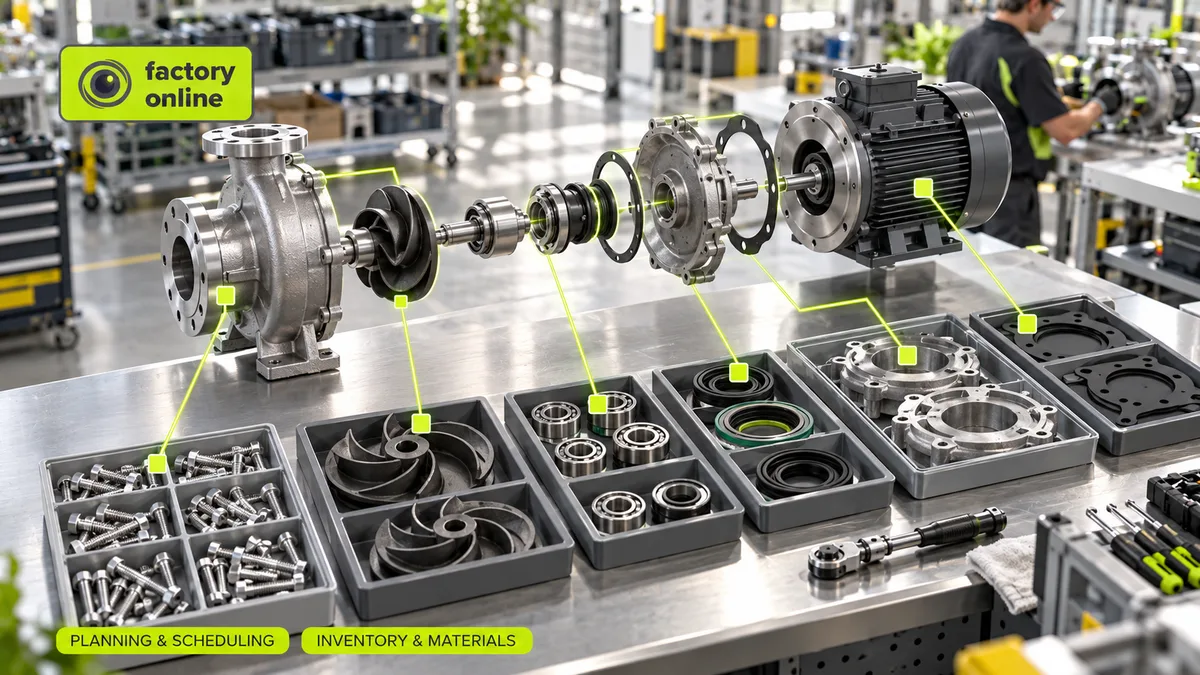
Nobody who runs a bakery forecasts eggs by looking at last month's egg consumption. They look at how many cakes they will bake and read the recipe. Three eggs per cake, 40 cakes, 120 eggs. The only real guess is the cakes.
That is the whole idea behind dependent demand. Dependent demand is demand for an item that follows from the demand for another item: the components, materials and subassemblies that go into a product you plan to build. Independent demand comes from outside: customers ordering finished products or spare parts. Independent demand has to be forecast. Dependent demand can be calculated. Mixing them up is an expensive mistake.
Independent vs dependent demand
A simple test: would anyone order this item if you stopped making the product it goes into?
- Finished pumps: yes, customers order them. Independent demand. Forecast it, or take it from the order book.
- Pump housings: only because pumps are built. Dependent demand. Calculate it.
- Fasteners: only because pumps are assembled. Dependent demand too.
Dependent demand is calculated by walking down the bill of materials: the product's recipe, with quantities per unit.
Worked example: 100 pumps
The plan is to assemble 100 pumps in week 6. Each pump needs 1 housing and 4 fasteners.
Gross requirements:
- Housings: 100 × 1 = 100
- Fasteners: 100 × 4 = 400
Netting the housings. There are 30 usable housings in stock, and 20 more are due from the machining department in week 5, before assembly starts. Net requirement: 100 − 30 − 20 = 50 housings.
Netting the fasteners. 250 in stock, nothing on order. Net requirement: 400 − 250 = 150. Fasteners come in boxes of 200, so the buyer orders one box. After assembly, 200 − 150 = 50 fasteners stay on the shelf for the next order.
Timing. Housings and fasteners are needed at the start of assembly, not on the ship date. If housings are machined in-house from castings, and machining takes a week, the 50 new housings must start machining in week 5 at the latest, which means 50 castings must be on hand by then. Each level down moves the date earlier by that level's lead time. This is the calculation MRP runs every night, for every part.
One part, two kinds of demand
The same housing is also sold as a spare part. Service customers buy about 15 a month, and that demand really is independent: nobody knows exactly which pump will crack.
So the housing has two sources of demand:
- Dependent: 100 for the pumps being built, calculated from the plan.
- Independent: about 15 for spares, forecast from service history.
Total gross requirement: 100 + 15 = 115, so after the same 50 in stock and on order, the net need is 65. Forecast only the spares and let the BOM calculate the rest.
How forecasting components double-counts
What many plants do instead: someone sees that housing consumption averaged 110 a month over the last quarter (pumps plus spares) and puts 110 in the housing forecast.
Then MRP explodes the pump plan and adds its own 100 housings. Planning now sees 110 + 100 = 210. Real need is 115. The plant plans 210 − 115 = 95 housings nobody will use, plus the castings under them, plus the machining hours to make them.
The history was correct, the BOM was correct. The error was forecasting a number that should have been calculated. The fix is a rule: forecast only independent demand, which means finished goods and spare parts, and let the BOM drive everything else. Where the forecast for finished products comes from is the job of demand planning.
Myth: "Dependent demand is certain, so there's no risk"
The quantity is certain once the parent plan is fixed. The risk moves elsewhere:
- The parent plan changes. Move the pump order a week earlier and every housing, fastener and casting date moves with it. A free assembly slot does not mean the components can follow.
- The BOM is wrong. A drawing change put 6 fasteners on each pump, the BOM still says 4. The calculation is precise and wrong: it misses 200 fasteners.
- Stock is not really usable. Housings on quality hold, or in another building, count in the stock report but not on the line.
This is also why one missing component stops everything in assembly. A pump with 99% of its parts is 0% of a pump, the problem explored in assembly planning.
Quick checklist
- Does every component get its demand from a BOM, not from a forecast?
- Are spares and service kits forecast separately, and only once?
- Is "usable stock" released by quality, in the right place, and not reserved?
- Are lead times at each BOM level current, so the dates offset correctly?
What the planner sees in factory.online
In factory.online, MRP explodes the 100-pump manufacturing order through the multi-level BOM, subtracts the 30 housings in stock and the 20 from the open machining order, and shows a shortage of 50 housings linked to that specific pump order. A separate sales order for spare housings creates its own demand on the same item, so the planner sees both sources side by side instead of one blended forecast.
If your planners have ever found a pallet of components nobody ordered on purpose, let's look at where it came from in a demo.