

24 Aug 2026
Assembly Planning: The One Missing Screw Problem
Eight parts are on the bench and the ninth arrives Thursday. Should you start? Learn the full-kit rule, clear to build, and the real cost of half-built units.
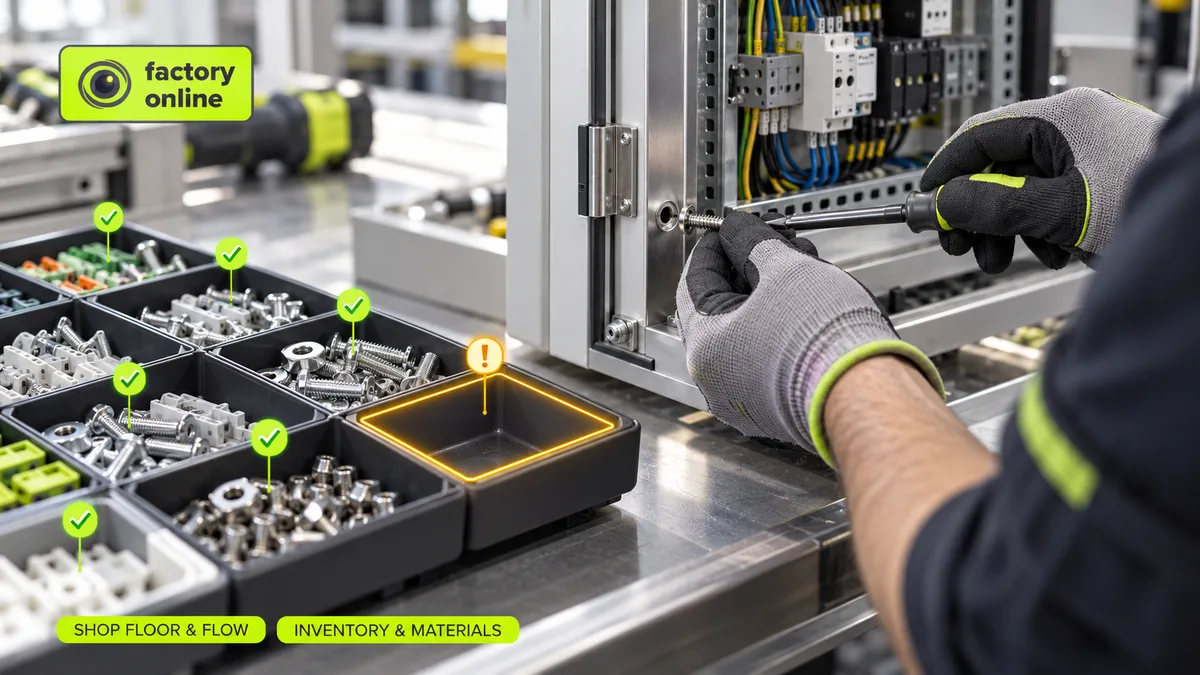
Eight of the nine parts for a control cabinet are on the bench. The ninth, a door lock, arrives Thursday. The bench is free, the fitter is standing there, and it is Monday. Do you start?
Most shops start. It feels productive. Often it is the most expensive decision of the week. Assembly planning is deciding which assembly orders to start, and when, so that every component and subassembly arrives at the bench at the moment it is needed and each started unit can be finished without stopping. The one missing part matters more than the eight that are there.
The full-kit rule
People trained in the Theory of Constraints call it the full kit: don't start a job until everything it needs is there. Chefs call it mise en place: every ingredient chopped and measured before the pan goes on the stove. Nobody starts a cake and then discovers there are no eggs, because by then the flour, butter and sugar are already mixed and can't go back in their bags.
Assembly is the same. Once you start, components are consumed, a fixture is occupied and the unit can't easily go back on the shelf.
Clear to build: one number every assembly plant should know
Clear to build (CTB) is the share of planned orders that have every component available. It is the quickest health check an assembly planner can run on Monday morning.
This week there are 10 cabinet orders. Eight have a full kit. Two are waiting for the door lock. Clear to build is 8 of 10 = 80%.
Note what the 80% does not mean. It doesn't mean you are 80% ready overall, or that the two short orders are 80% complete. Those two can't ship at all until Thursday. CTB is also where MRP earns its keep: shortages are exploded from the bill of materials and routing of each order, so you know on Monday, not Wednesday, which orders are short. How that calculation works is explained in MRP.
What blocked WIP really costs
Say the shop has 6 assembly fixtures and each cabinet occupies one fixture for two days. From Monday to Wednesday that is 6 × 3 = 18 fixture-days of capacity. The eight fully kitted orders need 8 × 2 = 16 of them. Tight, but it fits.
Now the team starts the two short orders on Monday anyway. They build everything except the door and park the cabinets in their fixtures until the lock arrives. Those two fixtures are blocked for three days: 2 × 3 = 6 fixture-days, a third of the capacity. That leaves 12 fixture-days, enough for only 6 of the 8 kitted orders. Two orders that had everything they needed are now late too.
It gets worse. Each parked cabinet holds about $900 of components that can't be used for anything else, and each one has to be reopened, rechecked and finished later, perhaps 40 minutes of extra work per unit. When the lock arrives Thursday, the "head start" has cost more time than it saved. The general version of this is Little's Law: more work started doesn't mean more finished.
Myth: keep the bench busy
The instinct is that an idle fitter is waste. But a fitter building a unit that can't be finished is not producing output; they are producing a problem for Thursday. The better use of Monday is to build the fully kitted orders, pull a later order forward if its kit is complete, or prepare subassemblies that don't need the missing part.
Controlled partial release: frame before accessories
The full-kit rule has one sensible exception. Some parts go on at the very end and don't block anything: a door lock, labels, a handle, a manual. If the missing item is one of those, you can release the order in stages:
- Stage 1: frame, mounting plate, wiring and testing. Everything is on hand.
- Stage 2: door lock and final inspection, released when the lock arrives.
Three conditions make this safe:
- the missing part is fitted at the end and nothing needs to be taken apart to add it;
- the half-built unit can leave the fixture and wait on a shelf, not on the bench;
- the arrival date is confirmed by the supplier, not hoped for.
That is the whole difference in the cabinet example. The same two cabinets, built to stage 1 and moved off the fixtures to a shelf, would have blocked nothing.
If the frame is built on its own and waits for many different final products, it may deserve its own item number and stock location. That design choice is discussed in semi-finished goods.
An assembly planning checklist for Monday
- What is this week's clear-to-build percentage?
- For each short order, which part is missing, and when does it arrive?
- Is the missing part fitted at the end, or does it block the build?
- Can a later, fully kitted order be pulled forward instead?
How it looks in factory.online
In factory.online, MRP runs through the multi-level BOM of each cabinet and links every shortage to the order that caused it. On Monday the planner sees that orders 9 and 10 are short two door locks, that a purchase order for them is due Thursday, and that the other eight orders have everything. On the Gantt, the planner can see where next week's fully kitted orders would fit into the free fixture time.
If your benches are full and your shipments aren't, book a demo and we'll look at one of your stuck orders.