

23 Nov 2026
Batch Processing: 12 Oven Slots Need Three Loads for 24 Parts
An oven has 12 rack positions, but 24 parts need three cycles because large parts occupy two positions each. A four-hour plan becomes six hours before anything breaks.
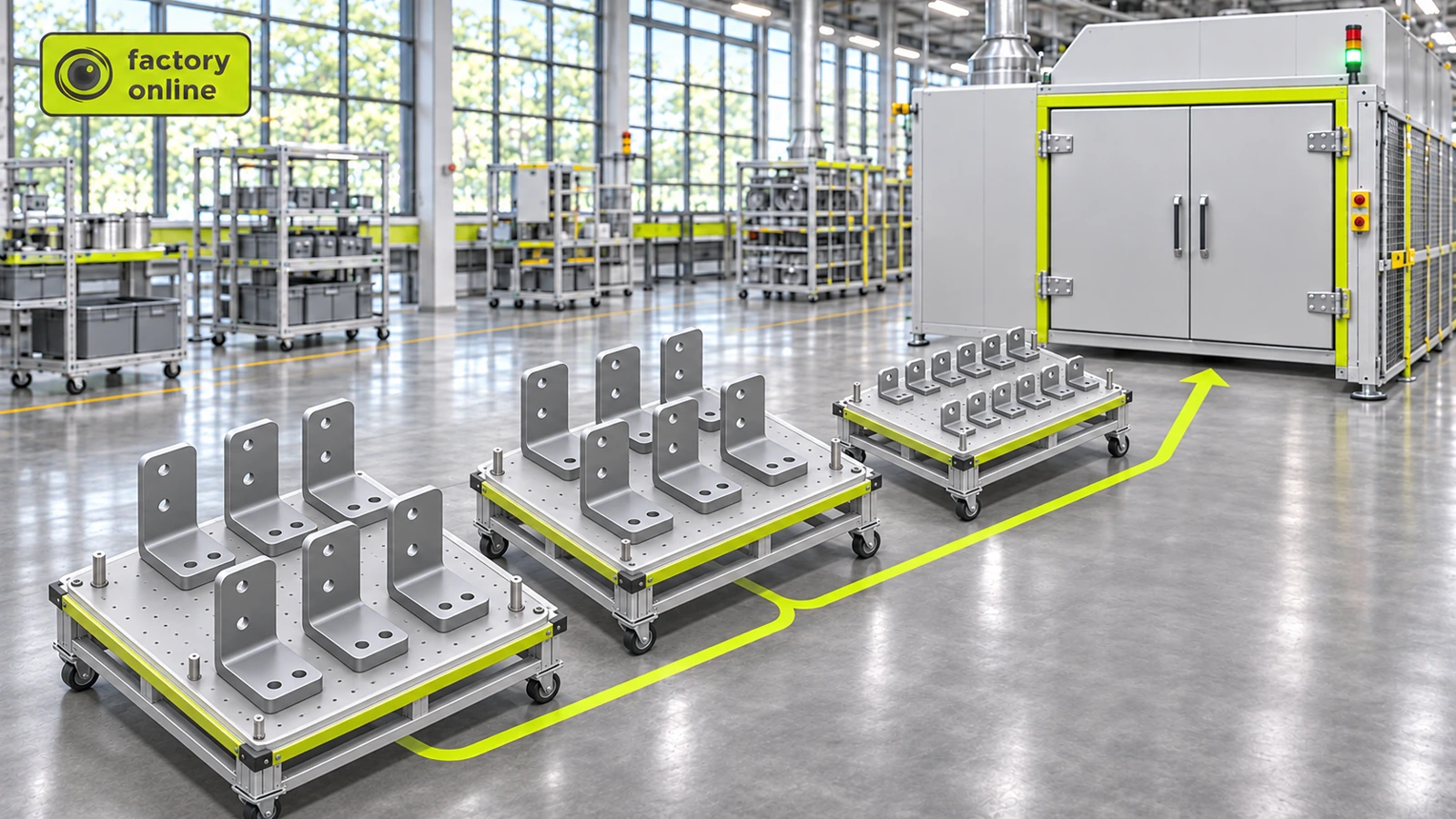
An oven has 12 rack positions. The order contains 24 parts, so the planner reserves two cycles. At noon, the team discovers that a third load is still waiting. The oven has run exactly as planned; the load calculation has not.
Batch processing runs a group of parts through the same processing cycle together. Its capacity depends on the approved load configuration, including the space each part occupies, rather than a single parts-per-cycle number.
Calculate batch processing capacity from the load map
Consider an order for coated steel brackets: 12 large and 12 small. All brackets are ready for the oven before 08:00.
The approved rack has 12 usable positions. A large bracket occupies two adjacent positions; a small bracket occupies one. Parts cannot overlap or be stacked. The approved loading map preserves the required clearances.
Each oven cycle occupies two hours, including loading, the specified thermal process, cooling and unloading. That duration belongs to this process route. The oven is available from 08:00 to 16:00, with trained staff covering each loading and unloading period.
All 24 brackets must leave the oven by 14:00 for the next operation. Later inspection and packing have their own reserved time.
The original calculation counts pieces:
24 parts ÷ 12 positions \= 2 cycles.
2 × 2 hours \= 4 hours.
Starting at 09:00 appears to give a 13:00 finish. But a position and a part are different units.
The correct load is:
12 large × 2 positions \= 24 positions.
12 small × 1 position \= 12 positions.
24 + 12 \= 36 position requirements.
36 ÷ 12 \= 3 full loads.
The production route and resource capacity must describe the same loading rule. A generic capacity of 12 pieces per cycle loses the distinction.
Three cycles that actually fit
Total position demand gives a lower bound on the cycle count. The planner must also show that the parts fit each load.
Here, a valid loading plan is straightforward:
- Load 1: six large brackets, using all 12 positions.
- Load 2: six large brackets, using all 12 positions.
- Load 3: twelve small brackets, using all 12 positions.
All parts use the same approved cycle. Even if a permitted mixed load combines large and small brackets, the total still requires three cycles. Mixing cannot squeeze 36 position requirements into 24 positions.
Three cycles occupy:
3 × 2 hours \= 6 hours.
At the original 09:00 start, the cycles end at 11:00, 13:00 and 15:00. The final brackets leave one hour after the 14:00 requirement.
The plan is short of one cycle, not a faster loading team.
Move the start before buying overtime
The oven is free at 08:00, and all brackets and staff are available then. Moving the first load forward gives:
- 08:00–10:00: Load 1.
- 10:00–12:00: Load 2.
- 12:00–14:00: Load 3.
The full order meets the 14:00 requirement without overtime or displacing another order. It has no time buffer, so the planner should keep that exposure visible.
A second oven is another option only if it is approved for this process and has a suitable rack and available staff. Transfer and preparation time belong in that comparison.
Squeezing more brackets onto the rack is not an equivalent capacity increase. A revised load configuration needs process approval before it enters the schedule. Likewise, a shorter thermal cycle needs an approved route, rather than a planner reducing the duration to make the date fit.
The same distinction matters in changeover planning: time saved by a verified process change is usable capacity; time removed from a spreadsheet is a promise.
Myth: A half-full-looking rack has spare capacity
A large bracket can leave visible air around itself while occupying two required positions. That space protects access, clearance or the approved loading arrangement.
Think of a home dishwasher. A large pan can occupy the space of several plates. Counting 12 objects tells you little about whether the door will close with the approved arrangement.
For the brackets, the decision rule is specific: convert quantities into occupied positions, build valid loads, then reserve the complete cycle for each load. When different recipes cannot share a cycle, calculate those groups separately.
In factory.online, the planner can represent the three oven loads as job orders and compare their placement in a finite-capacity Gantt schedule. A planning scenario makes the difference between the 09:00 and 08:00 starts visible alongside other production commitments.
If your batch plan fits by piece count but misses the next operation, let's examine the loads behind your schedule.