
3 Aug 2026
Production Routes vs. Machine Capacity: Why Your Cable Plant Is Running Below True OEE
Having 20 drawing and extrusion lines doesn't mean you have 20 lines of usable capacity. Learn how complex cable routes, setup conflicts, and routing constraints silent-kill your equipment utilization.
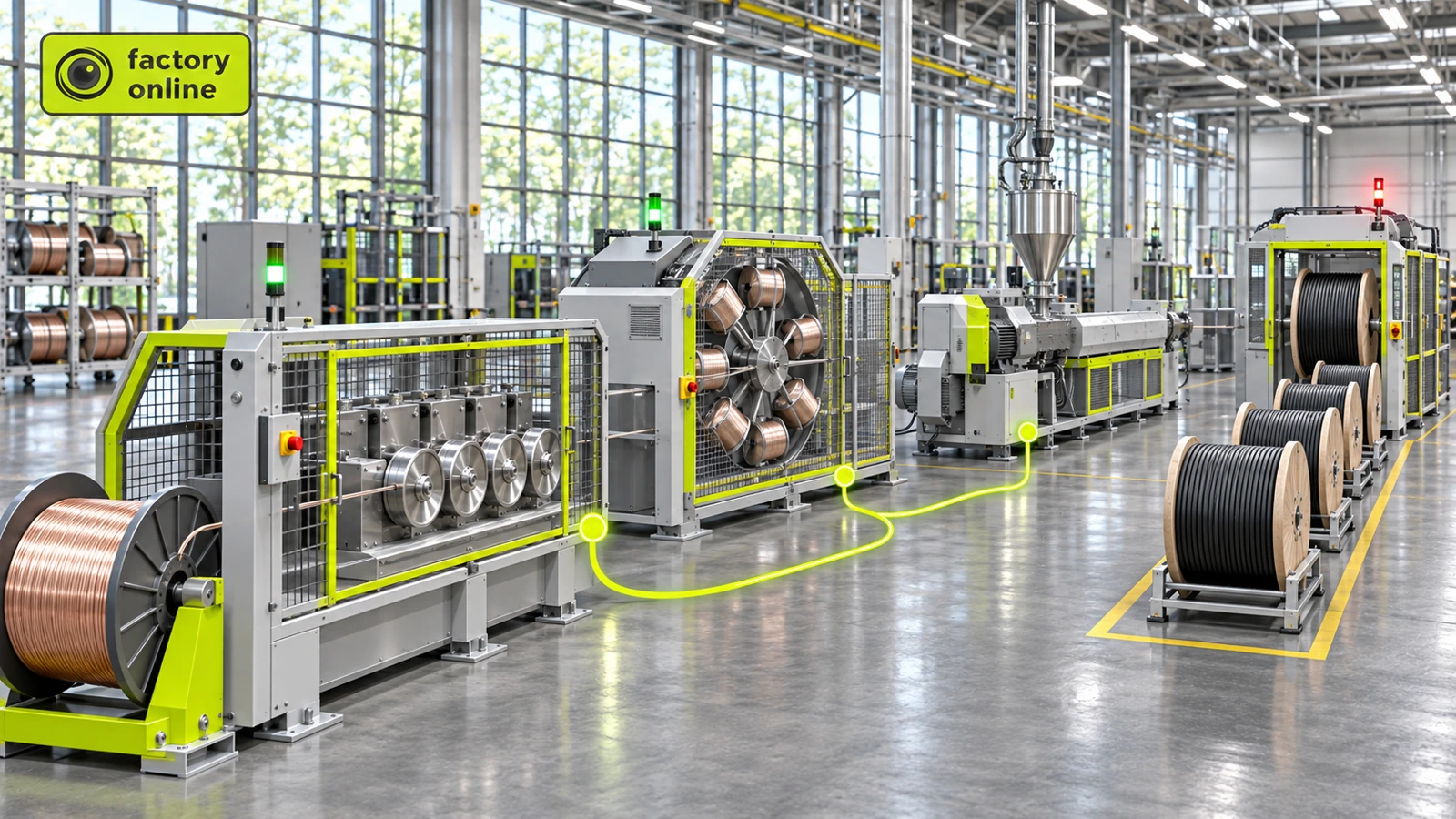
The floor manager's dashboard shows 85% equipment utilization, yet customer orders are delayed, and two key extrusion lines are backed up until Thursday. The rest of the plant looks busy, but spool reels sit idle in front of closed armor lines waiting for the right gauge conductor.
A modern cable manufacturing facility can own millions of dollars in advanced machinery, but installed equipment isn't usable capacity. Managing a plant that produces dozens of cable constructions—from low-voltage power cables to complex multi-core shielded control cables—means that true efficiency isn't about counting available machines. It is about understanding how routing choices, line constraints, and setup sequences dictate the real physics of your shop floor. Volume is easy to schedule; balancing cross-process flow across interconnected lines is the real job.
The Invisible Bottleneck: Why 10 Lines Don't Equal 10x Capacity
Consider a plant with three drawing machines, four stranding lines, and three insulation lines. On paper, capacity planning calculates total available machine hours by multiplying lines by operational shifts: 10 lines × 24 hours \= 240 machine hours a day.
The reality hits during execution:
- Equipment Restrictions: Not every line handles every conductor cross-section or insulation compound. Line 2 can run XLPE at high speeds, but lacks the specific crosshead required for flame-retardant zero-halogen (LSZH) compounds.
- Process Interdependency: A high-spec armored cable must pass through drawing, rigid stranding, insulation, cabling, armoring, and outer sheathing. If the rigid stranding machine takes an extra 4 hours for a drum switch, the downstream sheathing line sits starved—regardless of how much "open capacity" the schedule showed for sheathing that morning.
Planning based on machine averages creates imaginary capacity. When orders are assigned without factoring in exact line capability and upstream dependencies, the result is uneven utilization: two lines run into heavy overtime while three others sit waiting for work in progress (WIP).
The High Cost of Uncoordinated Route Planning
When production scheduling relies on static routing templates or high-level ERP assumptions, four silent profit killers appear on the factory floor:
- Changeover Chaos: Switching an extrusion line from PVC to XLPE or changing color masterbatches takes significant scrub and setup time. Running small batches out of sequence wastes up to 20% of daily line capacity purely on thermal transitions and die changes; see changeover optimization.
- WIP Floor Congestion: Drums and spools stack up in staging areas because intermediate steps (like braiding or tape screening) were scheduled without checking buffer capacity at the next station.
- Constant Schedule Friction: Dispatchers constantly swap jobs on the floor to keep workers active, triggering a chain reaction of missed customer delivery dates downstream.
- Distorted OEE Metrics: Overall Equipment Effectiveness looks acceptable on paper because machines are "running," but a large chunk of that run time is spent processing low-margin filler jobs or running at reduced speeds due to sub-optimal tool pairings.
Myth: Adding More Equipment Solves Your Capacity Problem
When lead times stretch, the instinctive response is often to invest in another extrusion line or additional payoff stands. But in most cable plants, the constraint isn't a lack of physical machinery—it's routing fragmentation and poor sequence optimization.
Buying a new $500,000 line doesn't fix a schedule that switches insulation compounds four times a day, nor does it help when three different jobs require the same specialized caterpillar capstan at the exact same hour. Capital expenditure often just moves the bottleneck to another part of the line. Optimization starts with routing logic, not new machinery.
How it looks in factory.online
In factory.online, cable manufacturing routes are mapped down to individual line constraints, compound compatibility, and drum capacity. Instead of treating every extrusion line as an identical work center, the system automatically routes jobs based on real-time tool availability, setup transition rules (such as dark-to-light color matrix sequencing), and upstream WIP flow.
The finite-capacity Gantt chart gives planners full visibility into multi-stage cable production: if a stranding process runs late, all downstream sheathing and testing operations shift dynamically to reflect true floor conditions. Planners can run realistic "what-if" scheduling scenarios to see how inserting an urgent custom cable order impacts overall plant utilization before a single reel is loaded.
BEEDIGIT collects machine and operator data for OEE, downtime and actual production reporting. These records help the team compare planned capacity with what the equipment actually achieved and investigate recurring losses.
If your floor management team is tired of balancing theoretical capacity against actual output, book a demo with us and bring your most complex cable routing structures.