

9 Feb 2026
S&OP for Manufacturers: The Forecast Is Not the Plan
Marketing plans a +20% promotion. Does anyone ask the coating line? Learn how S&OP turns a forecast into line hours, options and owners, in a monthly five-step cycle.
Marketing has a great idea for the spring: a promotion on the best-selling product family, expected to lift sales by 20%. The campaign is approved, the artwork is printed, the distributors are told. Six weeks later, the coating line is running every weekend and still can't keep up. Nobody asked the coating line.
That is exactly the conversation S&OP (sales and operations planning) exists for. S&OP is a monthly process in which sales, operations, purchasing and finance agree on one plan for demand and supply, usually by product family, 12 to 24 months ahead, and decide what to do where they don't match. The forecast says what customers might buy. The S&OP plan says what the company will do about it, and who does what.
The forecast is not the plan
A weather forecast says it will probably rain on Saturday. The plan is whether you move the barbecue indoors, rent a tent or change the date, and who picks up the tent. You don't argue about whether the forecast is "right". You decide what to do given the forecast.
S&OP works the same way. A forecast of +20% is an input. The plan answers: will we build ahead, add shifts, narrow the promotion, or accept some late orders? A forecast without a decision just passes the problem to the production planner six weeks later, when the options are fewer and more expensive.
Worked example: turning +20% into coating-line hours
The promoted family currently sells 3,000 units a month. Each unit needs 0.1 hours on the coating line. The coating line has 480 hours a month (20 days, three shifts), and the other product families already use 140 of them.
Normal month: 3,000 × 0.1 = 300 hours for the family, plus 140 for the others = 440 hours. Spare: 480 − 440 = 40 hours.
Promotion month: +20% is 3,000 × 0.2 = 600 extra units, which need 600 × 0.1 = 60 extra hours. Load: 440 + 60 = 500 hours against 480. Short by 20 hours.
So 60 extra hours are needed, and only 40 exist. Here are the options S&OP puts on the table, each with a cost and an owner:
- Build ahead. The month before the promotion also has 40 spare hours. Building 200 units early (200 × 0.1 = 20 hours) takes the promotion month back to 480 of 480. Cost: 200 units of finished stock for a month, plus warehouse space. Owner: operations, with finance approving the stock.
- Add capacity. Two 10-hour weekend shifts cover the 20 hours. Cost: overtime. Owner: the plant manager.
- Shrink the promotion. The 40 spare hours carry 40 ÷ 0.1 = 400 extra units, about 13% instead of 20%. Owner: sales and marketing.
- Accept some late orders. Rarely the right answer, but sometimes the honest one. Owner: sales, who has to tell the customers.
Note what "build ahead" leaves behind: two months at or near 100% on the coating line, with no room for a breakdown. S&OP does not need to schedule individual jobs, but it does need to see that kind of risk. The hours come from rough-cut capacity planning, and the material for 200 early units has to be checked too.
The monthly S&OP cycle in five steps
Most companies run S&OP as a monthly rhythm with five steps:
- Data update. Close last month: actual sales, production, inventory. Refresh the statistical forecast.
- Demand review. Sales and marketing agree the demand plan by family, including promotions, new products and big tenders. This is where demand planning feeds in.
- Supply review. Operations checks the demand plan against key resources and critical materials, and lists the gaps with options.
- Reconciliation (pre-S&OP). A small team prices the options, prepares the scenarios and writes down which decisions are needed.
- Executive S&OP meeting. Leadership decides. Each decision gets an owner and a date. The agreed volumes go into the master production schedule, which breaks them into products and weeks.
The meeting in step 5 should be short. If it runs three hours, the earlier steps didn't do their job.
Myth: "S&OP is a forecasting meeting"
This is the most common way S&OP fails. The meeting turns into a review of forecast accuracy charts: last month we said 3,100, we sold 2,950, why? Everyone nods, nothing is decided, and the same coating-line problem shows up again next month.
S&OP is a decision meeting with owners. A good test is the minutes. If they contain sentences like "approve build-ahead of 200 units in March, operations to confirm materials by the 10th", S&OP is working. If they contain only numbers, it is a reporting meeting with a fancy name.
Plan by family, check by mix
S&OP works in product families so the meeting stays manageable. But families can hide a mix problem. If the promotion favors a variant that needs 0.3 coating hours instead of 0.1, the same +20% in units needs three times the hours. The supply review should always check the promoted mix, not just the family total.
Promotions have a second hidden effect. Distributors stock up before the campaign and then order nothing for weeks afterward, so the factory sees a spike and a gap much bigger than real consumer demand. That is the bullwhip effect, and S&OP is the best place to plan for it, as shown in supply chain management for manufacturers.
FAQ
Who should attend S&OP? Sales, marketing, operations, purchasing and finance, plus someone senior enough to decide when they disagree. Usually the general manager or managing director.
What is the difference between S&OP and IBP? Integrated business planning (IBP) is a name often used for S&OP extended further into financial and strategic planning. The core habit is the same: one agreed plan, decisions with owners.
How long does it take to set up? The first cycles are rough. Start with the families that cause the most trouble and the three or four resources that most often limit output, and add more as the data improves.
How it looks in factory.online
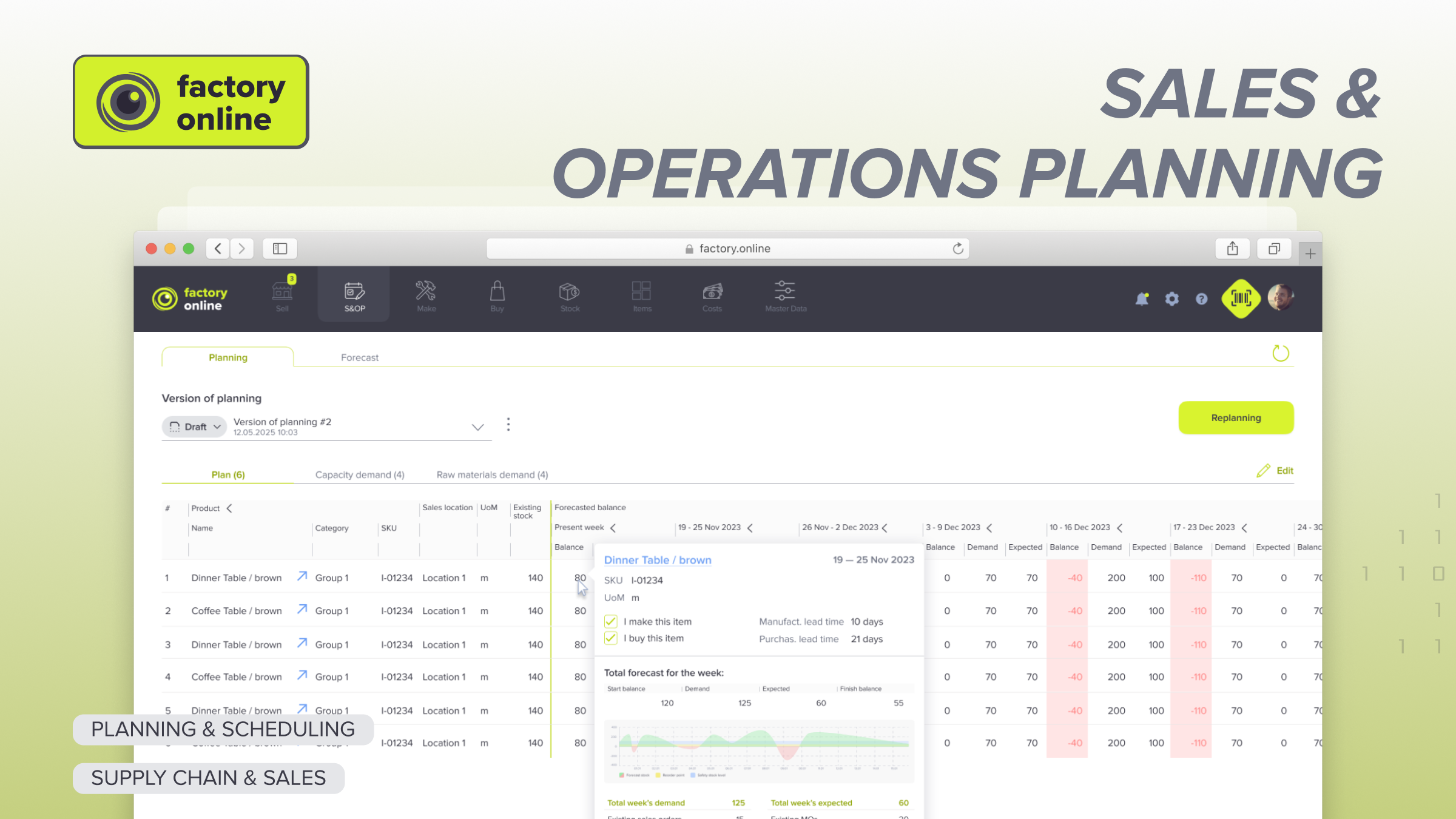
For the promotion, a planner in factory.online builds two planning scenarios: one with 200 units built a month early, one with weekend shifts. RCCP shows the coating line load month by month in each version, 480 of 480 in the promotion month for build-ahead, and MRP shows whether the materials for the early units can arrive in time. The supply review brings both scenarios to the meeting, and the approved one becomes the plan the shop schedule works from.
kafaa.ai offers product-mix optimization using demand, contribution margin and capacity constraints. This supports the discussion of which feasible production mix makes the best use of a bottleneck, alongside the detailed factory.online plan.
If your promotions get approved before anyone looks at the line, see how the supply review could look in a demo.