

6 Jul 2026
Sales Orders and ATP: How a Planner Checks a 'Friday' Promise
500 ordered, 200 on hand. Easy? Not quite. Follow a planner through available to promise (ATP), capable to promise (CTP) and the partial-shipment question, step by step.
Sales calls at 4 p.m. on Monday. A customer wants 500 units by Friday. The stock screen shows 200. Easy: make 300 more and ship? Not quite. By the time a planner has checked properly, the real gap is 230, and only part of it can be made by Friday.
A sales order is a customer's firm commitment to buy a quantity of a product by a date. In a factory it is also a question: can we deliver this, from what, and when? Answering that question before saying yes is called order promising, and it rests on two checks: available to promise (ATP) and capable to promise (CTP).
Step 1: On hand is not available
Of the 200 units on the shelf, 80 are already allocated to another customer's order that ships Thursday. They are physically there, but they are spoken for.
Think of a restaurant. The table by the window is empty, but there is a "reserved" card on it. You can't seat walk-ins there just because nobody is sitting at it yet.
So the first number is 200 − 80 = 120 units free today.
Step 2: Add what is coming, if nobody has claimed it
Production has an order for 150 units due to finish on Wednesday. Before counting them, the planner checks one thing: are those 150 already promised to someone else? Here they are not.
Available by Friday: 120 + 150 = 270. The customer wants 500. Uncovered: 500 − 270 = 230 units.
That is available to promise (ATP): stock on hand, minus what is already allocated, plus scheduled receipts that nobody has claimed yet, counted period by period. ATP answers "what can I promise from supply that already exists or is already planned?"
Step 3: Capable to promise, can we make the rest?
ATP stops at existing supply. The 230 units need new production, and that is where capable to promise (CTP) comes in. CTP asks whether materials and capacity exist to make the missing quantity in time.
The planner checks two things:
- Materials. The BOM for 230 units needs 460 brackets. There are 600 in stock, 100 of them allocated to other orders. 500 free covers 460. Fine.
- Capacity. The assembly cell makes 40 units per hour. 230 units need 230 / 40 = 5.75 hours. The cell is booked solid until Thursday, with 4 free hours on Thursday afternoon. 4 × 40 = 160 units.
Result: 160 more units can be ready by Friday. The last 230 − 160 = 70 need 70 / 40 = 1.75 hours, which fits into next Monday morning. After testing and packing, they ship Tuesday.
Step 4: Partial shipment or ship complete?
Now the planner has a real answer instead of a guess:
- Friday: 120 + 150 + 160 = 430 units.
- Tuesday: the remaining 70 units.
Whether that works depends on the customer. Some accept a partial shipment gladly: 430 units keep their line running. Others insist on ship complete, because two deliveries mean two receipts, two invoices and two chances for error. Then the honest promise is all 500 on Tuesday.
Ask the customer; don't guess. The worst answer is to promise "Friday" for 500 and ship 430. At order level that counts as a failed delivery, which is why OTIF punishes partial surprises so hard.
The myth: "If it's in stock, I can promise it"
This is the most common promising mistake, and it fails in both directions.
It over-promises when stock is allocated, on quality hold, or sitting in the wrong warehouse. The screen said 200; the truth was 120.
It also under-promises. A salesperson who sees 200 and knows nothing about Wednesday's 150 or Thursday's free capacity might say "200 now, the rest in three weeks." The customer goes to a competitor, and the Thursday slot goes unused.
The fix: check allocations, then scheduled receipts, then capacity. In that order.
ATP vs CTP: promising sales orders
- ATP uses stock and supply that already exist or are already planned. It is fast and reliable, and it is enough for most make-to-stock items.
- CTP adds a check of materials and capacity for new production. It is slower and depends on good routings and calendars, but it is the only honest answer for make-to-order products.
Where your factory draws that line is a strategic choice. Make-to-order vs make-to-stock explains how to decide which products are promised from stock and which from capacity. And if a surprise order like this keeps arriving every Monday, it probably wasn't a surprise. Demand planning shows how to see it coming.
How factory.online helps
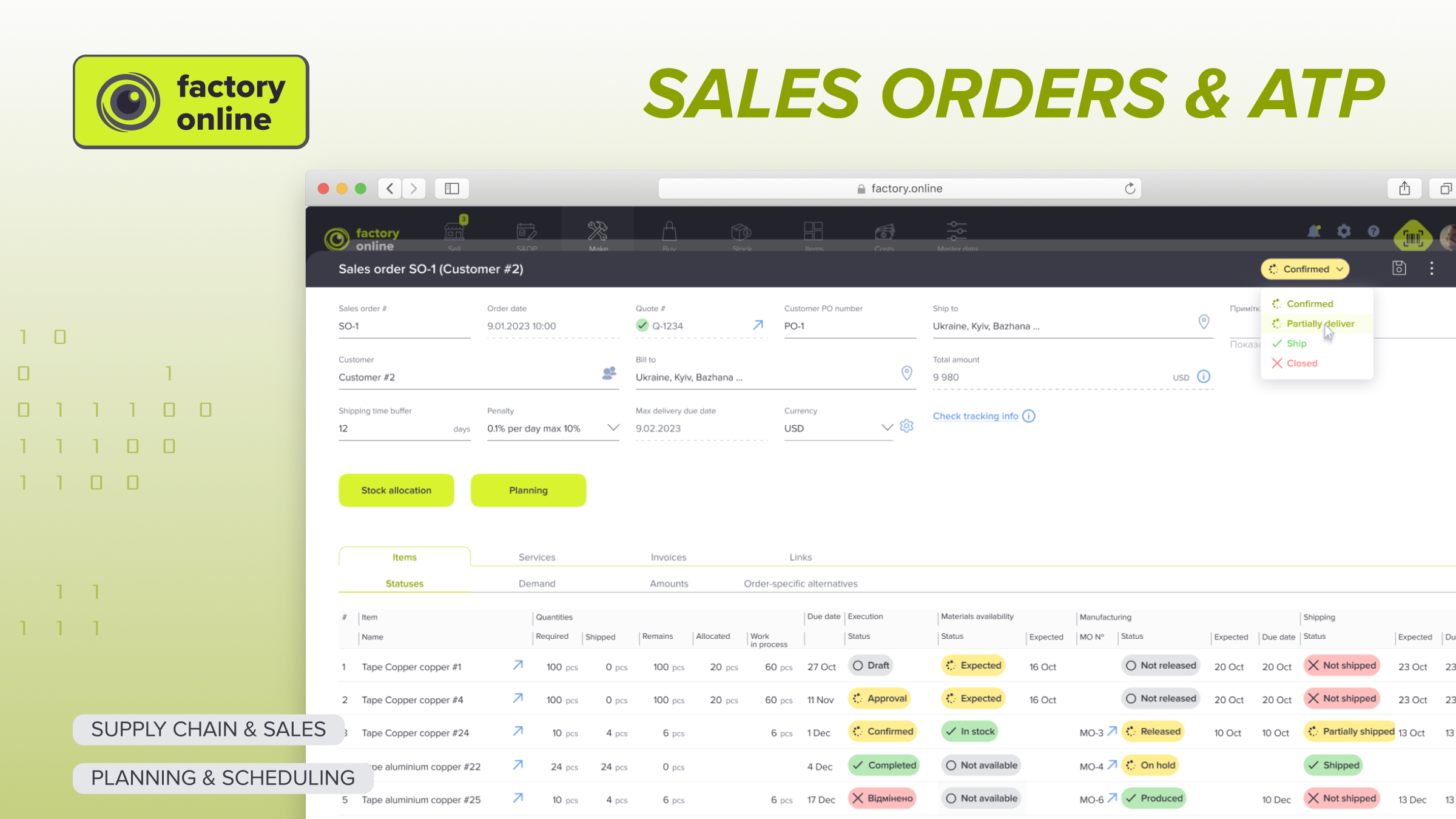
In factory.online, a sales order creates manufacturing demand directly. The planner sees the 80 allocated units, the Wednesday production order, the bracket stock against the BOM, and the free Thursday hours on the scheduling Gantt in one place. When the 230 extra units are confirmed, they become a manufacturing order and a job order for the assembly cell, still linked to the customer order, so if the Thursday slot slips, it's clear whose delivery is at risk.
FAQ
Is ATP the same as free stock? No. Free stock is today only. ATP also counts unclaimed receipts, period by period.
Should sales see ATP directly? Yes, for items promised from stock. For make-to-order items, a quick CTP check by planning avoids promises the plant can't keep.
If your planners do these four steps in a spreadsheet every time sales calls, book a demo and bring last Monday's order with you.