
7 Oct 2025
Item Master Data: How One Cable Becomes 4,000 SKUs
Eight cross-sections, five core counts, five colors, two materials and ten markings make 4,000 SKUs. Learn how matrix BOMs, alternatives and batch-level marking keep item master data under control.
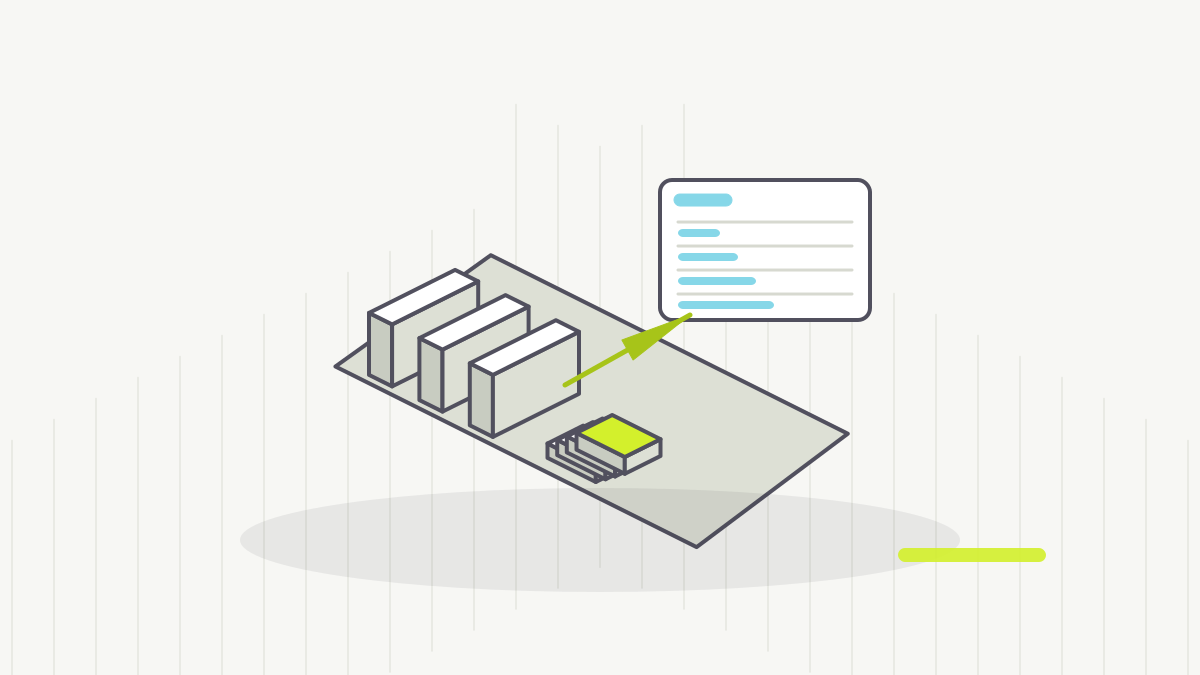
A cable plant makes one product: a flexible power cable. Then sales adds cross-sections, core counts, sheath colors, a halogen-free version and customer markings. Nobody decided to have 4,000 SKUs. They just arrived, one reasonable request at a time. Now every new compound supplier means editing hundreds of BOMs by hand.
Item master data is the central record of every item a plant buys, makes, stores or sells: its code, description, unit, characteristics, and the BOM and routing that define how it is made. Product variants are versions of one basic product that differ in a few characteristics. How you model those variants decides whether your item master is a tool or a second full-time job.
How product variants multiply: the cable arithmetic
Take one cable family and count the choices:
- 8 cross-sections: 0.75, 1, 1.5, 2.5, 4, 6, 10 and 16 mm²
- 5 core counts: 2, 3, 4, 5 and 7
- 5 sheath colors
- 2 insulation materials: PVC and halogen-free (LSZH)
8 × 5 × 5 × 2 = 400 products. Now add marking: the text printed on the sheath. There is the standard marking, three export versions and six customers who want their own name on the cable. That is 10 marking versions, and 400 × 10 = 4,000 SKUs.
If each SKU has a BOM with six lines (copper, insulation compound, color masterbatch, filler, sheath compound, packaging) and a routing with five operations, you are maintaining 24,000 BOM lines and 20,000 routing steps. Most are copies. A new sheath compound supplier means touching thousands of records, and missing a few.
One matrix BOM instead of 400 copies
The copies all follow the same rules, so store the rules once. A matrix BOM holds the possible components of the whole family and ties each quantity to the characteristics. Copper is a good example. Copper weighs 8.96 g/cm³, so one meter of 1.5 mm² conductor holds 1.5 cm³, or about 13.44 g. A 3-core 1.5 mm² cable needs 3 × 13.44 ≈ 40 kg of copper per km, plus a little for the twist of stranding. That one rule, cross-section × cores × density, covers all 400 products.
A matrix routing does the same for operations. Every variant is drawn, insulated, stranded and sheathed, but the line speed depends on cross-section, and only the halogen-free version needs a different extrusion setup. One routing with rules replaces 400 routings with copies. The difference between the BOM and the routing is explained in BOM and routing.
Think of a pizzeria. It doesn't keep a recipe card for every size, crust and topping combination. It has one dough recipe scaled by size and a rule for each topping. Nobody calls that less precise.
Myth: "Every variant needs its own BOM"
It feels safer. It is the opposite. With 400 copied BOMs, a correction reaches the 380 you remembered and misses the 20 you didn't. With one matrix, the correction reaches all of them at once. The precision is in the rule, not in the number of copies.
When the "same size" isn't the same item
The opposite mistake is merging things that only look alike. A 3 × 2.5 mm² cable in PVC and one in LSZH have the same dimensions and the same copper. For a tunnel project that requires halogen-free cable, they are not interchangeable. If they share one SKU, the stock report says "yes" and the site inspector says "no."
The test: combine two things under one code only if they can replace each other for every use. The same question applies to intermediate products like insulated cores, as discussed in semi-finished goods.
Alternatives: 1:1 and 1:many
Some materials can replace others without being the same item:
- 1:1. Sheath compound from supplier A or supplier B. Two SKUs, because you need to know which one went into which batch, but either one satisfies the BOM.
- 1:many. One kg of pre-colored blue PVC can be replaced by 0.98 kg of natural PVC plus 0.02 kg of blue masterbatch. One main material is replaced by two different ones.
Marking versions at batch level
Back to the 4,000. The ten marking versions don't change the copper, the compound or the process. They change what the printer writes on the sheath. So instead of 3,600 extra SKUs, keep 400 products and record the marking version on each batch. A drum of batch 24-1187 carries "Customer A" printing, and anyone can see that before it is allocated to Customer B. How that batch link pays off when a customer asks questions later is covered in batch traceability.
How factory.online handles cable variants
In factory.online, the 400 cable items can be generated from a material class and its characteristics in one step, instead of being typed one by one. A matrix BOM and a matrix routing supply the copper, compounds and operations for each combination. The sheath compound from two suppliers is set up as a 1:1 alternative, and the natural PVC plus masterbatch as a 1:many alternative. Marking versions are tracked per batch without duplicating products, and designs can be imported from PDM or PLM systems rather than re-entered. More on how these variants flow through the plant is in cable manufacturing planning.
If your item master grows faster than your team can maintain it, book a demo and bring one product family's characteristics with you.