

17 Aug 2026
Cable Drums and Containers: The Empty Drum That Stops a Finished Order
Copper ready, extruder booked, and the only free drum is too small. Learn a simple formula for how much cable fits on a drum, and why returnable drums you expect aren't drums you have.
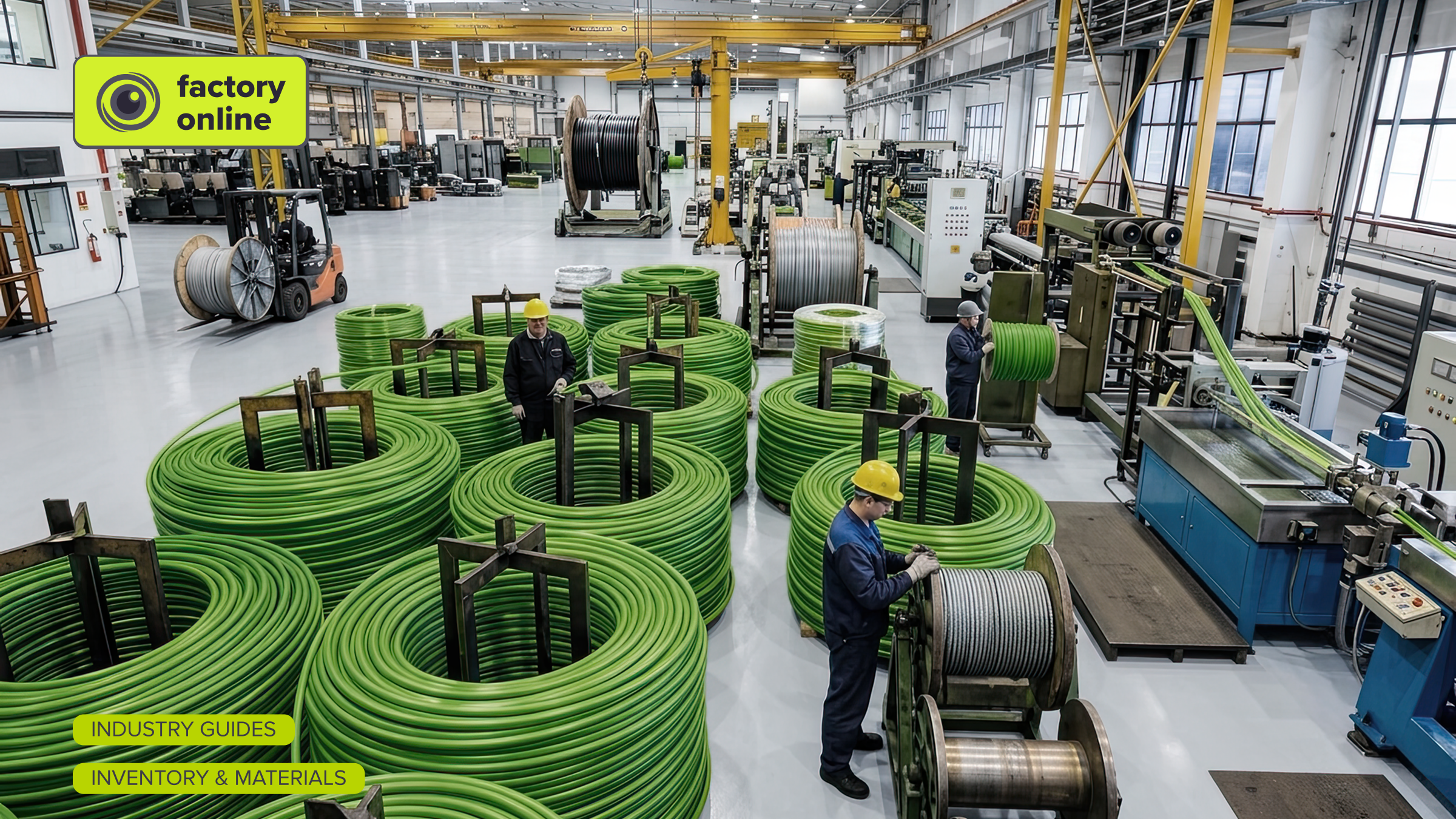
The copper is drawn and stranded. The extruder is booked for Tuesday morning. The customer wants one continuous 1,000 m length. Then someone walks to the yard: the only free drum is too small. The order stops for lack of an empty wooden reel.
Cable drums are the reels that cable is wound on, both between production steps and for shipping to the customer. In cable planning they are not just packaging. A drum decides how long a continuous length you can make, move and ship, so a missing drum can block a finished order just as surely as missing copper.
Cable drum capacity: how much cable fits?
Planners should be able to answer this before release, not at winding. A widely used approximation, all dimensions in millimeters:
L (m) ≈ π × (D\_barrel + H) × H × W / d² / 1000
- D\_barrel is the barrel (core) diameter of the drum.
- H is the winding height: flange diameter minus barrel diameter, halved, minus a free clearance left at the flange edge.
- W is the traverse width, the inside width between the flanges.
- d is the cable diameter.
The logic: H / d is the number of layers, W / d is the number of turns per layer, and π × (D\_barrel + H) is the length of an average turn. Multiply them and convert millimeters to meters.
A worked example
A drum with a 1,600 mm flange, an 800 mm barrel and a 1,000 mm traverse. You leave 100 mm of clearance below the flange edge. The cable is 40 mm in diameter.
- H \= (1,600 − 800) / 2 − 100 \= 400 − 100 \= 300 mm
- Average turn diameter \= 800 + 300 \= 1,100 mm
- L ≈ π × 1,100 × 300 × 1,000 / 40² / 1000
- \= π × 330,000,000 / 1,600 / 1000
- \= π × 206.25 ≈ 648 m
So this drum holds roughly 650 m of a 40 mm cable. The 1,000 m continuous order doesn't fit, and two drums won't help: the customer needs one piece.
Try a bigger drum: 2,000 mm flange, same 800 mm barrel, 1,200 mm traverse, same 100 mm clearance.
- H \= (2,000 − 800) / 2 − 100 \= 500 mm
- L ≈ π × 1,300 × 500 × 1,200 / 1,600 / 1000 ≈ 1,530 m
That works, with room to spare.
Notice the d² in the formula. A cable just 10% thicker (44 mm instead of 40) fits only 1 / 1.1² ≈ 83% as much on the same drum: about 535 m instead of 648 m.
Treat the result as an approximation. Real winding is never perfectly tight, so many plants keep a small margin or check against the drum supplier's tables. One rule the formula doesn't show: the barrel must not be too small. The minimum barrel diameter is usually a multiple of the cable diameter, based on bending radius, set per the cable specification. Check it for each cable type.
Think of a garden hose reel. You can't wind 50 m of thick hose onto a reel made for 30 m of thin hose, however hard you push.
Process drums vs shipping drums
Most plants run two drum pools.
- Process drums carry conductor, cores and cabled assemblies between steps and cycle inside the plant. When they run out, upstream stages stop: finished work has nowhere to go.
- Shipping drums leave with the customer. They must match the ordered length, the customer's handling equipment and often a drum type named in the contract.
Rewinding from a process drum to a shipping drum is real work: a machine, a person and time. Plan it as an operation, not an afterthought in the yard. Keep the length, its drum and its batch linked, so you can later trace which drum carried which lot, as described in batch traceability.
Returnable drums: expected is not available
Many customers return empty drums, so it's tempting to count them as stock before they arrive. Look at the numbers first.
Say 40 of your drums are out at customers, and 25 are due back this month. From past months, you know about 60% of due drums arrive on time, and about 1 in 10 returns needs repair before reuse.
- On time: 25 × 0.6 \= 15 drums
- Usable: 15 × 0.9 \= 13.5, so plan on 13 drums, not 25
Planning with 25 means twelve winding operations will find no drum waiting for them.
The myth: "An empty drum is an empty drum"
Size, barrel diameter, load rating, condition, location and allocation all matter. Ten empty drums in the yard can mean zero usable ones for Tuesday's order: three are too small, four are promised to other orders, two are waiting for repair, and one is at the other site.
A drum count tells you little. A drum check asks: right size, free, serviceable, in the right place, before the operation starts?
Drums as part of the bigger cable picture
Drums are one of three length gates in cable production. The others are the multi-stage route, covered in cable manufacturing planning, and continuous fiber lengths, covered in fiber optic cable planning. After winding come the last steps before the truck leaves, described in finished goods.
How factory.online helps
In factory.online, each drum can be tracked as a container holding a batch with its own length, item and location. The planner sees that drum 214 holds 1,040 m of core in the extrusion queue. Shipping drums can sit in the BOM like any other material, so a missing 2,000 mm drum shows up as a shortage against the order before Tuesday's release, not at winding.
If your winding team discovers drum problems before your planners do, book a demo and bring one of those orders along.