
All industries

28 sie 2026

Assembly & Miltech

High-mix assembly for MilTech and DefTech: distributed sites, fast engineering changes, serial-number traceability from supplier to handover.

Metalworking and mechanical engineering operations often run as high-mix, route-dependent production with strong constraints driven by machines, tooling, and skilled labor.

factory.online helps metal plants increase throughput, reduce WIP, and improve delivery performance by combining constraint-based planning with real execution visibility.

Specific challenges in metal & mechanical plants:

  • Routing variability: each job follows unique operations; rework/inspection loops change routing dynamically.
  • Bottleneck drift: constraints move between machining, heat treatment, finishing, QA, and dispatch depending on mix.
  • Setup-dependent scheduling: tooling changes, fixture availability, CNC program readiness, and setup families.
  • Tooling and gauge constraints: limited special tools, fixtures, measuring equipment, and calibration windows.
  • Skilled labor constraints: dispatching must respect operator skills, shift patterns, and certification requirements.
  • External processing: subcontracted operations (coating, heat treat) break the plan and hide WIP.
  • Quality gates and inspections: hold/release cycles cause unpredictable queues and lead-time growth.
  • Manual reporting and weak feedback: missing actual start/finish times prevents accurate capacity planning.
  • Costing gaps: actual cycle times, scrap, and downtime not captured reliably.

**What factory.online delivers:

  • High-mix routings overload one bottleneck machine → APS sequences finite capacity across work centres and alternative machines, so the constraint sets the pace instead of blocking it.
  • Jobs disappear between machining, subcontract and assembly → WIP tracking with subcontract stages shows where every part is and how long it has been waiting.
  • Delivery dates are promised from gut feeling → RCCP and what-if simulation validate the date against real machine calendars, shifts and holidays before you confirm the order.
  • Real cost per part is unknown until it is too late → actual costing collects machine time, setup, scrap and rework per operation and compares it with the standard.
  • Tooling and material shortages surface on the shift start → MRPII plans materials and tooling from the released schedule and flags gaps days ahead.
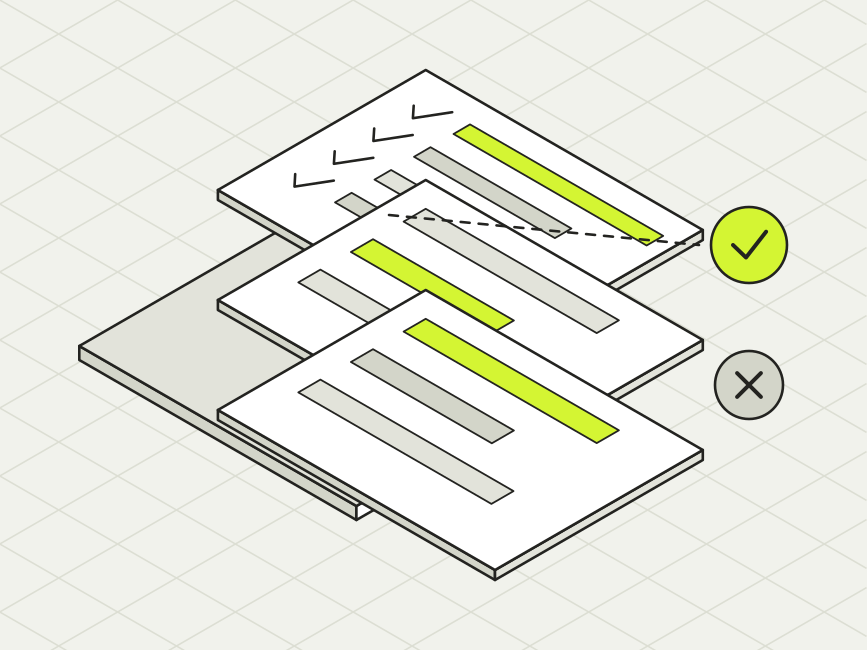

Pain → solution

What factory.online closes in Assembly & Miltech

Each module and add-on below is mapped to a concrete problem on your shop floor.

Scaling from a workshop to 5-10x serial volumes breaks manual coordination in messengers and Excel.

Finite-capacity APS sequences assembly and machining across sites and keeps the plan stable as volumes multiply.

Dozens of distributed and hardened sites create blind spots: nobody sees where a unit is or which serials went into it.

Work orders and WIP tracking give end-to-end serial-number traceability for every component, from supplier to handover.

PlanningModule

Assembly stalls because one part sits at another site and nobody knew it was missing.

MRP plans against real stock across every site, so kits are complete before the line starts.

PDMAdd-on

Engineering changes outrun the shop: a batch can be built to an outdated drawing or firmware v1.0 instead of v2.1.

PDM keeps items, drawings, firmware and revisions under one version control and releases only the approved version to production.

Inventory and transit are scattered across remote warehouses tracked in spreadsheets and chats.

Stocks gives one live view of balances and inter-site transfers, with role-based access that never exposes site locations.

Component and currency swings make it impossible to recalculate unit cost fast enough to quote safely.

Costing keeps planned and actual cost per order side by side and shows the variance as soon as it appears.

Przykłady zastosowań

Przykłady zastosowań w branży metalowej i budowie maszyn

Konkretne scenariusze, które nasi klienci automatyzują w pierwszej kolejności — od oferty po wysłaną paletę.

Zlecenia produkcyjne na podstawie rysunków

Dopuszczenie do produkcji opiera się na zatwierdzonej rewizji, więc cięcie na hali produkcyjnej nigdy nie odbywa się według nieaktualnego rysunku.

  • Kontrola rewizji
  • Powiadomienia o zmianach
  • Dostęp do dokumentów na hali produkcyjnej
Dodatek PDM

Optymalizacja rozkroju i uzysk materiałowy

Ewidencjonuj pozostałości arkuszy i prętów jako rzeczywisty zapas i wykorzystuj je ponownie przed zakupem nowego materiału.

  • Zapasy resztek materiałowych
  • Uzysk na zlecenie
  • Ponowne wykorzystanie pozostałości po cięciu
Moduł Stocks

Wieloetapowa marszruta technologiczna z podwykonawcami

Cynkowanie, obróbka cieplna lub malowanie są częścią marszruty technologicznej i mają własne czasy realizacji oraz koszty.

  • Operacje zewnętrzne
  • Śledzenie czasu realizacji
  • Zamówienia zakupu usług podwykonawczych
Moduł Production

Obciążenie maszyn i terminy dostaw

Planowanie przy ograniczonych zdolnościach produkcyjnych daje działowi sprzedaży termin, do którego może się zobowiązać, a hali produkcyjnej — wykonalną kolejność operacji.

  • Ograniczone zdolności produkcyjne
  • Widok wąskich gardeł
  • Deklarowane terminy realizacji
Moduł planowania

FAQ

Questions from manufacturers in this industry

Twoja fabryka zasługuje na więcej niż arkusze kalkulacyjne i zgadywanie