
Sep 17, 2026
The Hidden Problem in Automotive Manufacturing — It’s Planning
Automotive manufacturing: how the gap between planning and execution leads to losses. Discover how factory.online synchronizes orders, materials, and capacity in real time.
Today, the automotive industry is one of the most complex and sensitive sectors of manufacturing.
Hundreds of components in a single product, strong dependency on suppliers, multi-level cooperation, and constant order changes make production processes highly vulnerable to any deviations.
At the same time, deadlines are tightening, quality requirements remain uncompromisingly high, and market pressure continues to grow.
However, the key challenge of the industry lies elsewhere.
The main gap arises between planning and the actual execution of orders, and it is exactly within this gap that control, timelines, and profitability are lost.
Production dependent on planning accuracy
In the automotive industry, production is a system where each order depends on dozens of factors, including component availability, equipment capacity, operation sequencing, customer priorities, and logistics.
Even a single missing component can stop the assembly of an entire product, and even a small deviation at one stage can trigger a chain reaction across the entire production process.
The higher the production volume and the more complex the product, the higher the cost of planning errors.
Where the planning gap appears
In practice, even advanced enterprises face planning limitations. A plan may look correct in ERP systems or spreadsheets, but it does not reflect real production conditions.
As a result, plans do not consider actual material availability, order changes are not synchronized with production, equipment capacity is calculated without real constraints, priorities are adjusted manually, and production reacts to disruptions instead of managing them.
The situation is further complicated by fragmented data, as some information resides in ERP systems, some in spreadsheets, and some in separate tools or with individual employees.
As a result, companies formally have a plan, but lack a controllable production system.
Where money is really lost
In the automotive industry, losses arise not only in production but also at the planning stage.
They manifest in missed deadlines due to component shortages, accumulation of work-in-progress, excess inventory combined with part shortages, uneven equipment utilization, and constant rescheduling.
Each of these issues may seem operational, but together they lead to systemic losses, including increased costs, reduced turnover, and declining profitability.
Most importantly, these losses originate at the planning stage.
Scaling without synchronization
As a company grows, not only does the volume of orders increase, but so does the complexity of managing them.
If the planning system does not evolve accordingly, a predictable effect occurs: more orders lead to more chaos, more data reduces transparency, and more operations decrease controllability.
Externally, this appears as growth, but internally the system becomes unstable.
The faster the growth, the more pronounced this effect becomes.
The key to efficiency is synchronization of planning and production
In the automotive industry, it is impossible to manage production without synchronization.
Planning must reflect real constraints, and production must operate according to that plan.
This means that planning is based on actual data, materials, orders, and capacity are interconnected, changes are reflected in real time, and production operates within a controlled framework.
factory.online: when planning becomes controllable
This is exactly the challenge that factory.online addresses.
It is not just a planning system, but a tool that connects orders, materials, and production capacity into a unified and manageable system.
Unlike traditional ERP systems that record data, factory.online manages production through dynamic planning and process synchronization.
How it works
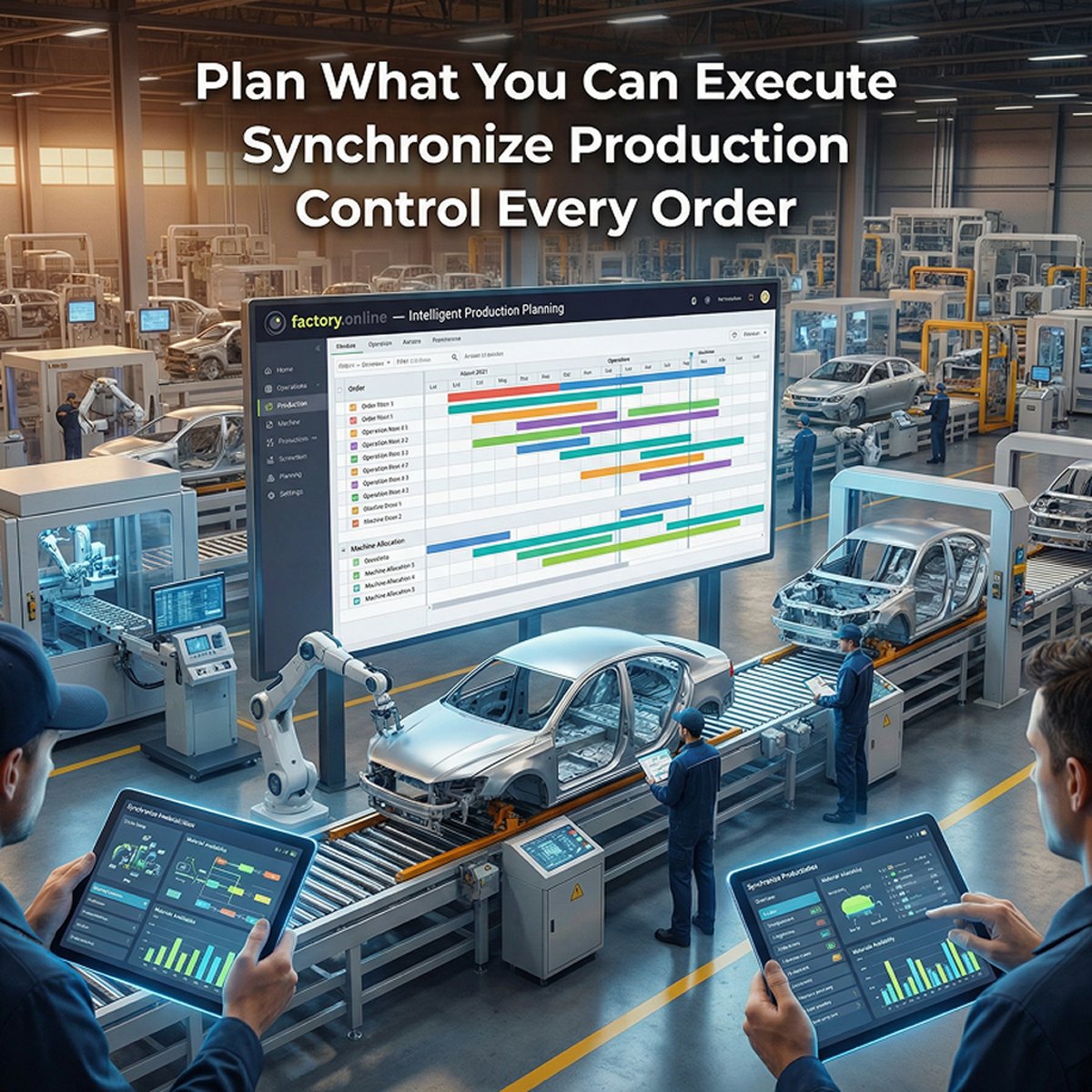
factory.online integrates data on orders, materials, and production capacity into a single system and creates a realistic production plan using MRP/MRPII and APS planning principles. The system automatically calculates material requirements, capacity loading, and order deadlines while taking real constraints into account, and continuously adapts to changes in orders and production conditions.
Management gains access to real-time dashboards that provide full visibility into workloads, deadlines, and deviations without the need for manual analysis.
As a result, companies move from static plans to a dynamic production model that reflects real conditions and enables real-time control.
From planning to control
When planning becomes realistic, the entire management approach changes, as the number of unplanned adjustments decreases, manual interventions are minimized, production predictability improves, and schedule deviations are reduced.
Production shifts from reactive operations to controlled execution.
Business impact
As a result, companies achieve shorter production lead times, reduced work-in-progress, optimized inventory levels, improved equipment utilization, and higher planning accuracy.
Most importantly, they gain control in an environment of high complexity.
Conclusion
In the automotive industry, profit is not only lost on the shop floor.
It is lost in planning, when decisions do not reflect real conditions.
And when planning is disconnected from production, control becomes impossible.
factory.online makes planning transparent, connected, and manageable.
This is the foundation for sustainable growth, control, and profitability.