

25 Oct 2026
QR Traceability in Electronics Assembly: The Label Is Only the Beginning
Two boards look alike but belong to different revisions. See how identification, revision records and assembly history work together in civilian electronics production.
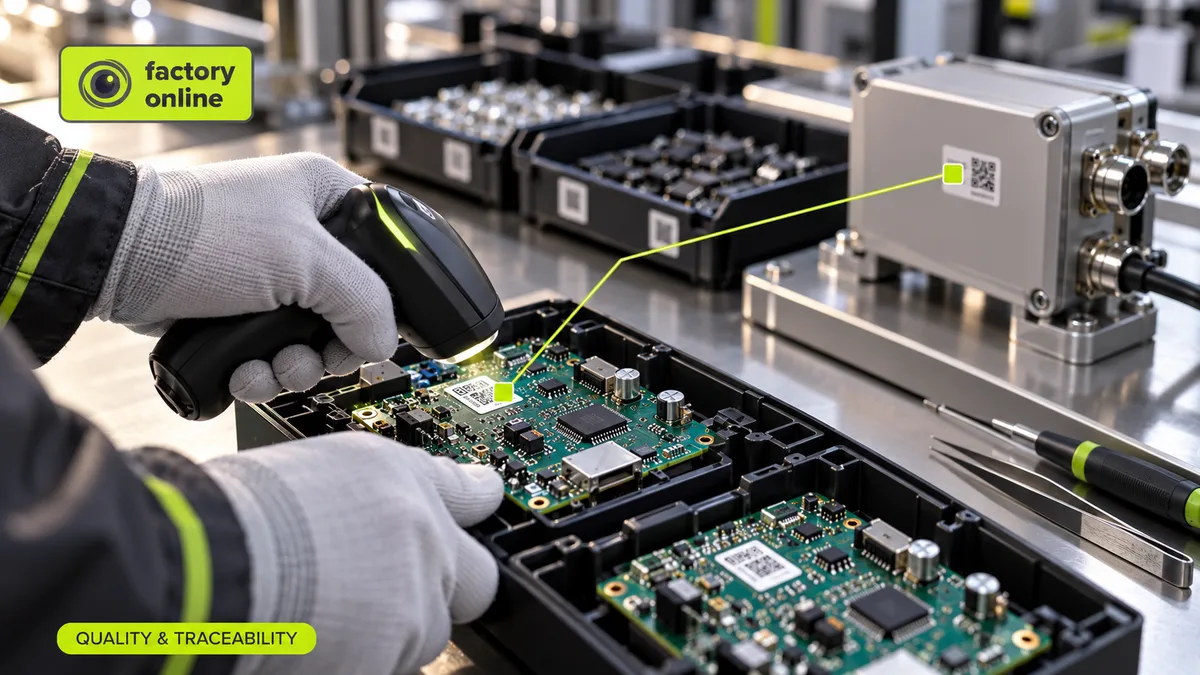
Two boards arrive at an assembly bench in identical trays. Their connectors look the same. One belongs to an earlier revision of a civilian industrial sensor; the other is intended for the current order. A visual check cannot reliably tell the operator which record to use.
The problem starts before final testing. The physical component and the production record have become disconnected. QR identification can help restore that connection, provided the record behind the label contains the information the team actually needs.
Identification is not the same as compatibility
A QR code is a way to find a record. It does not prove that a board is suitable for a product, that its firmware is current, or that it has passed inspection. Those decisions depend on controlled data and the agreed release process.
Keep three questions separate: what item is this, which revision or batch does it belong to, and where has it been used? A batch number groups components with shared origin. A serial number distinguishes one unit from another. The required level of detail should follow the service and quality questions your business needs to answer.
If a customer asks about one specific sensor, batch records alone may be insufficient. If the concern affects an entire supplier lot, recording individual serials without preserving the lot relationship also leaves a gap.
A simple example: 100 boards, two revisions
Consider an illustrative civilian electronics order for 100 sensors. The warehouse holds 60 boards of revision A and 60 of revision B. The order requires B. Total stock is 120, but only 60 boards match that requirement.
A single quantity against a generic item code hides the shortage of 40 suitable boards. Separate revision records make it visible before assembly begins. Recording which components were actually used then allows the team to distinguish finished products built with different approved configurations.
The useful result is a trustworthy history, rather than another label on a tray. It supports investigation, service and the isolation of affected stock when a quality concern arises.
What a traceability pilot should demonstrate
Start with a limited civilian product family and agree the questions the records must answer. Can the team follow a received batch to its recorded use? Can it trace a finished product back to the relevant material records? Does a label reprint retain the original identity? Are inspection status and revision visible to the people making the release decision?
Check exceptions as carefully as the normal path. An unreadable label, a returned component or an unrecorded transfer must have an owner and a documented way to reconcile the physical item with its record. Otherwise a successful scan can still lead to incomplete history.
Measure record completeness, time to retrieve the history and unresolved discrepancies. Do not treat the number of printed QR labels as evidence that traceability is complete.
Where factory.online fits
Inventory Management provides QR-based batch identification, warehouse movements and batch genealogy. Master and Product Data supports versioned BOMs and controlled transitions for open orders. Together these capabilities address different parts of the information chain.
Per-unit serial identification, firmware fields and any automatic compatibility blocking should be demonstrated for your specific workflow before they become rollout requirements. A general batch-traceability feature is not evidence that every such rule is already configured.
For the broader tracing principles, read Batch Traceability. For the distinction between received stock and stock released for use, see Raw Material Inspection.
Bring one civilian electronics product, its revision records and a real tracing question to a factory.online demo. That makes it possible to assess the required recording detail and the gaps a pilot needs to close.