

3 Aug 2026
Cable Manufacturing Planning: Busy Everywhere, Shipping Nothing
Drawing, stranding, insulation and sheathing all hit their targets, and nothing is ready to ship. See where cable lead time really goes, what copper in WIP costs, and why lengths and drums act as gates.
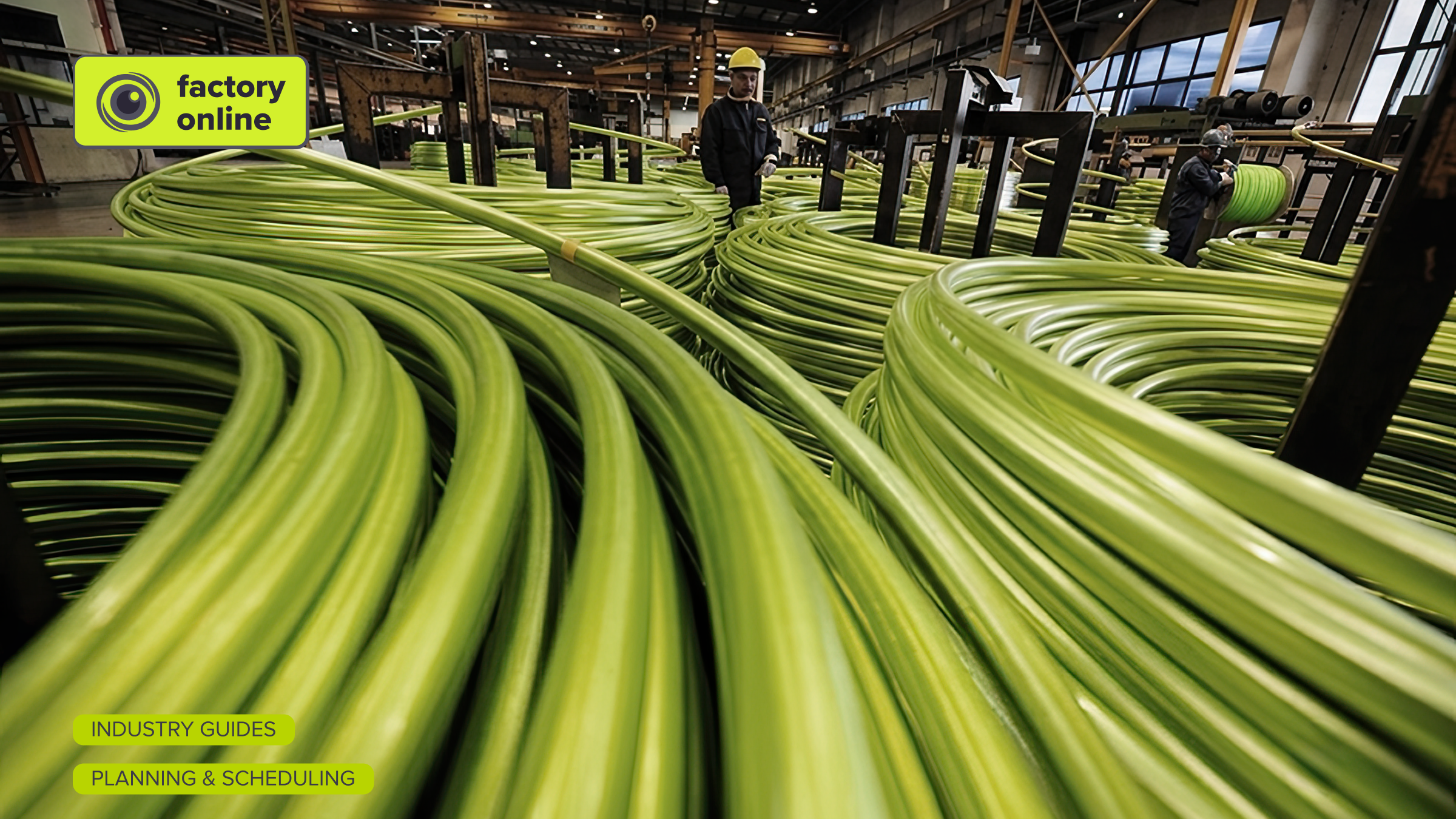
Walk through a cable plant on a Thursday afternoon and every department looks great. Drawing hit its tonnage. Stranding ran all three shifts. Insulation and sheathing both beat their weekly targets. Then you ask logistics what is ready to ship this week, and the answer is: almost nothing.
This is the classic cable paradox. Cable manufacturing planning is the job of moving each customer order through a chain of dependent processes, from copper rod to a tested cable on a drum, so that the right lengths arrive at the end at the right time. Keeping each machine busy is a different job, and the two often pull in opposite directions.
The cable production route, step by step
A typical power cable follows this route. Steps vary by product, but the shape is the same:
- Drawing. Copper or aluminum rod is pulled through dies down to wire of the required diameter.
- Stranding. Wires are twisted together into a conductor.
- Insulation (extrusion). A plastic or rubber compound is extruded around the conductor, making an insulated core.
- Cabling. Several cores are laid up together, often with fillers.
- Sheathing. An outer jacket is extruded over the whole assembly.
- Testing. Electrical and dimensional tests on the finished length.
- Winding. The cable is wound onto the shipping drum and labeled.
Now look at time. For one illustrative order, the machine time adds up like this: drawing 6 hours, stranding 10, insulation 12, cabling 8, sheathing 10, testing 4, winding 3. That is 53 hours of actual work, a little over two days. Yet the same order can easily spend three weeks in the plant.
The difference is waiting. Between steps, the product sits on a drum in a queue. That's where most of the lead time, and most of the money, sits.
Why busy machines don't mean shipped cable
Each stage has its own economics. Drawing and extrusion prefer long runs of the same size or compound, because every changeover costs time and scrap. So each department builds campaigns: all the 2.5 mm² this week, all the black PVC tomorrow.
Each campaign makes sense locally. Together, they produce half-products that don't fit together. Stranding has made conductor for orders that sheathing won't see until next week, while the one order due Friday waits for a core that insulation scheduled for Monday.
Think of a relay race where every runner is fast, but the baton lies on the ground for a minute at every handoff. Nobody on the team is slow. The team still loses.
The balance between long campaigns and fast flow is its own topic, covered in changeover optimization. The short version: size campaigns by what the next stage needs, not by what makes this stage look good.
Copper in WIP: what waiting really costs
Cable WIP is expensive because copper is expensive. Here is an illustrative calculation, using a round-number copper price of, say, $9,000 per metric ton. Plug in the day's price for your own.
Suppose your plant moves 5 metric tons of copper through production every working day, and copper spends on average 14 days between rod and shipped cable. By Little's Law, the copper sitting in WIP at any moment is:
- 5 t per day × 14 days = 70 t in WIP
- 70 t × $9,000 = $630,000 tied up
Only about two of those 14 days are actual processing. Now cut the waiting so the average drops to 8 days:
- 5 t × 8 days = 40 t, worth 40 × $9,000 = $360,000
- Cash released: $630,000 − $360,000 = $270,000
At a cost of capital of 10% a year, that's $27,000 a year in carrying cost alone, before counting the copper price risk on metal you have bought but can't yet invoice. Same machines, same output. Only the waiting changed.
The four kinds of WIP
Not all WIP is bad, and the fix depends on the kind. Walk the queues and sort each drum into one of four groups:
- Intentional buffers. Protect a planned downstream operation, usually the bottleneck. Keep them, and size them on purpose.
- Excess production. Made because the machine was free, ahead of any downstream slot. Stop releasing it.
- Blocked work. Waiting for a missing material, a free drum or a decision. Needs someone to unblock it, not more capacity.
- Displaced work. Pushed back again and again by changing priorities. Usually a sign that promising and scheduling aren't talking.
Start with the oldest and most valuable drums. For each, ask four questions: which order needs this, what is its next operation, what stops it moving, and when is it scheduled to run? If nobody can answer, more production won't help.
Lengths and drums: the gates nobody plans
In cable, quantity is not enough. An order for 3 × 1,000 m is not the same as an order for 3,000 m. A customer who needs 1,000 m continuous lengths can't use two pieces of 500 m, even though the stock report adds them up to 1,000.
That turns length into a gate at every stage. The conductor must be long enough for the core, the core long enough for the cabled assembly, and so on down the route, with process allowances at each step. Fiber optic plants face the same rule even more strictly, as described in fiber optic cable planning.
The second gate is the drum. Every intermediate length sits on a process drum, and every finished length needs a shipping drum of the right size. When the right drum isn't free, the line stops as surely as if copper had run out. How much cable fits on a given drum, and how to plan drums as capacity, is covered in cable drums and containers.
The myth: "If every department hits its target, the plant is fine"
Department targets measure output. Customers measure complete orders. A plant can raise tonnage at every stage and ship less, because the extra tonnage is the wrong mix in the wrong place.
A better test for the weekly meeting: how many orders moved one stage closer to shipping, and how many drums have waited longer than a week? Those numbers are harder to game.
Why cable master data makes it harder
One cable family can mean thousands of designs: cross-section, number of cores, insulation compound, color, sheath type, armor. Each design has its own data sheet, its own material norms per kilometer and its own technology card, and small differences change which machines and dies can run it. How a data sheet turns into norms and a technology card is shown in cable TDS, material norms and technology.
How factory.online helps
In factory.online, each intermediate length can be tracked as its own batch in a container, a drum with a known length and location, so the planner sees "1,040 m core on drum 17 in the insulation queue" instead of "3,200 m in stock". Each manufacturing order stays linked to the sales order behind it, so a waiting drum can be traced to its customer, and finite-capacity scheduling shows on the Gantt whether sheathing's Friday slot will actually have its input ready.
If your plant is busy everywhere and still late, book a demo and bring the list of drums that have been waiting longest.